
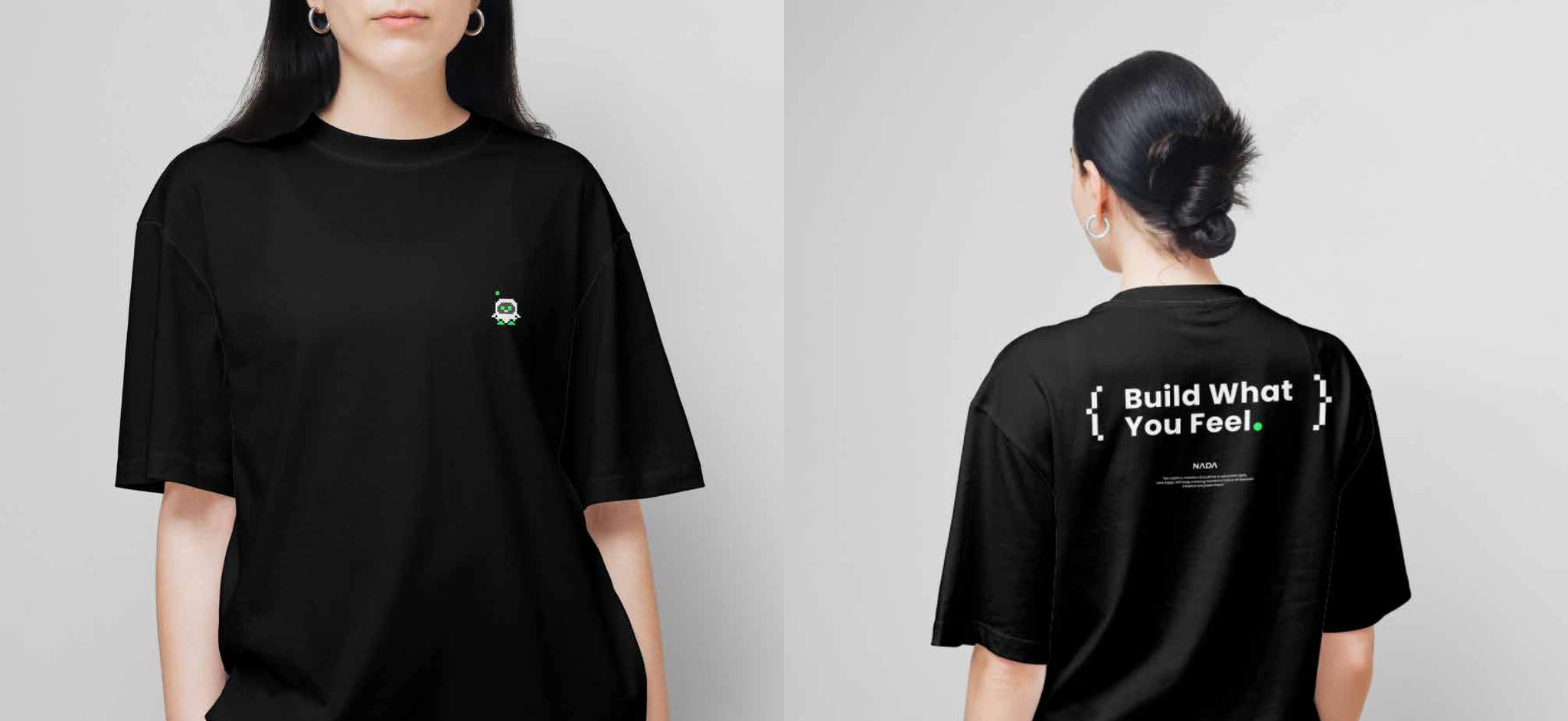
The test was simple: would someone reach for it on a day with no launch, no event, and no camera? That question shifted the work from merchandise to clothing: quiet at first glance, specific on the second, and at home in an ordinary wardrobe.
01 · The brief
First, remove the product.
The first decision was what to leave behind. Screenshots age. Interface language turns a shirt into documentation. An oversized logo asks the wearer to carry the brand before the garment can carry an idea.
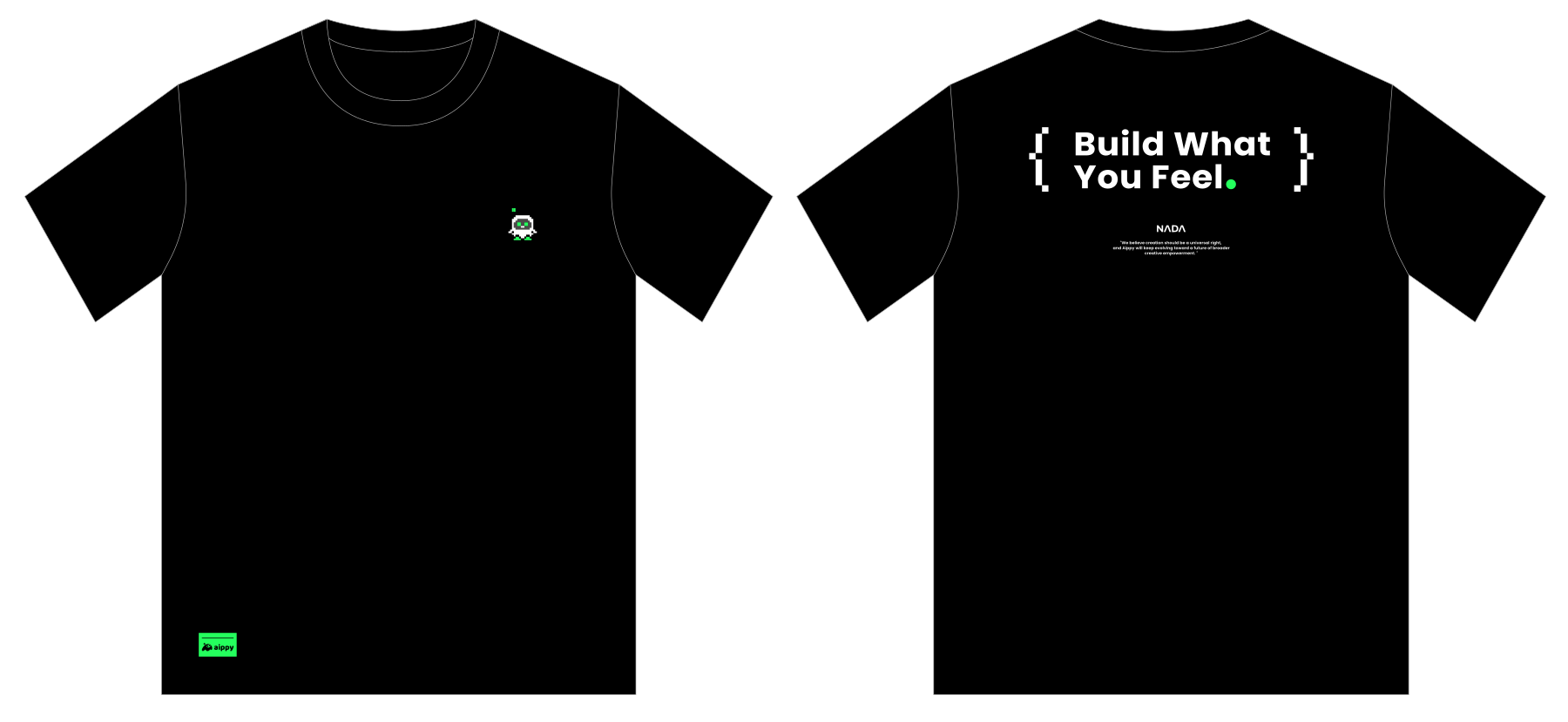
Only three elements survived: Boopy at the chest, an Aippy label at the hem, and “Build What You Feel” across the back. One acid-green accent links them.
Carry the belief. Leave the interface behind.
- 01Character over logo
Boopy gives the eye somewhere to land before the name appears.
- 02Belief over claim
The back offers a point of view, not a product promise.
- 03Accent with a reason
Green marks activation: antenna, eyes, feet, hem, final period.
02 · The close read
The front reveals itself in three beats.
From across a room: a black T-shirt. At conversation distance: Boopy at the chest. At arm’s length: an Aippy label at the hem.
That stagger matters. A single glance never exhausts the design, so the shirt registers as clothing before it registers as branding.
Most of the front is unprinted cotton. The empty field keeps each mark intact through folds and leaves the wearer’s face and posture in charge.

02A · Pixel studyBoopy, at sprite scale.
This is the original vector embedded in the selected T-shirt artwork—not a reinterpretation or a redraw. Its path coordinates, grid spacing, silhouette, face, antenna, eyes, feet, and source color values are preserved exactly.
At actual size, it reads as one compact chest mark. Enlarged, the original stepped contour reveals the deliberately coarse game-sprite logic used in the garment design. What appears here is the same artwork that appears on the shirt.
- 01Hard-edged grid
- 02Three-color read
- 03Legible at scale
03 · The long read
The back says what the front withholds.
“Build What You Feel” is not a feature claim. “Build” makes emotion active; “What You Feel” refuses to prescribe an outcome. It is broad enough for a wearer to borrow—and specific enough to feel like Aippy.
The brackets hold the phrase like a live command. A break after “What” controls the pace; the green period supplies the only chromatic full stop. NADA sits below at near-footnote scale: present, but never the subject.
04 · The edit
Four routes. One left room for a person.
The R1 study tested four ways to carry the same idea. One led with character. Another repeated the slogan. A third hid the phrase inside a binary field. The fourth stacked type around “Nothing Stops Your Creativity.”
Seen together, the difference is not volume alone. It is hierarchy. Three routes ask the back to do most of the work at once. The selected route gives each side one job: the front introduces; the back declares.
Open any direction to inspect the full-resolution source artwork.
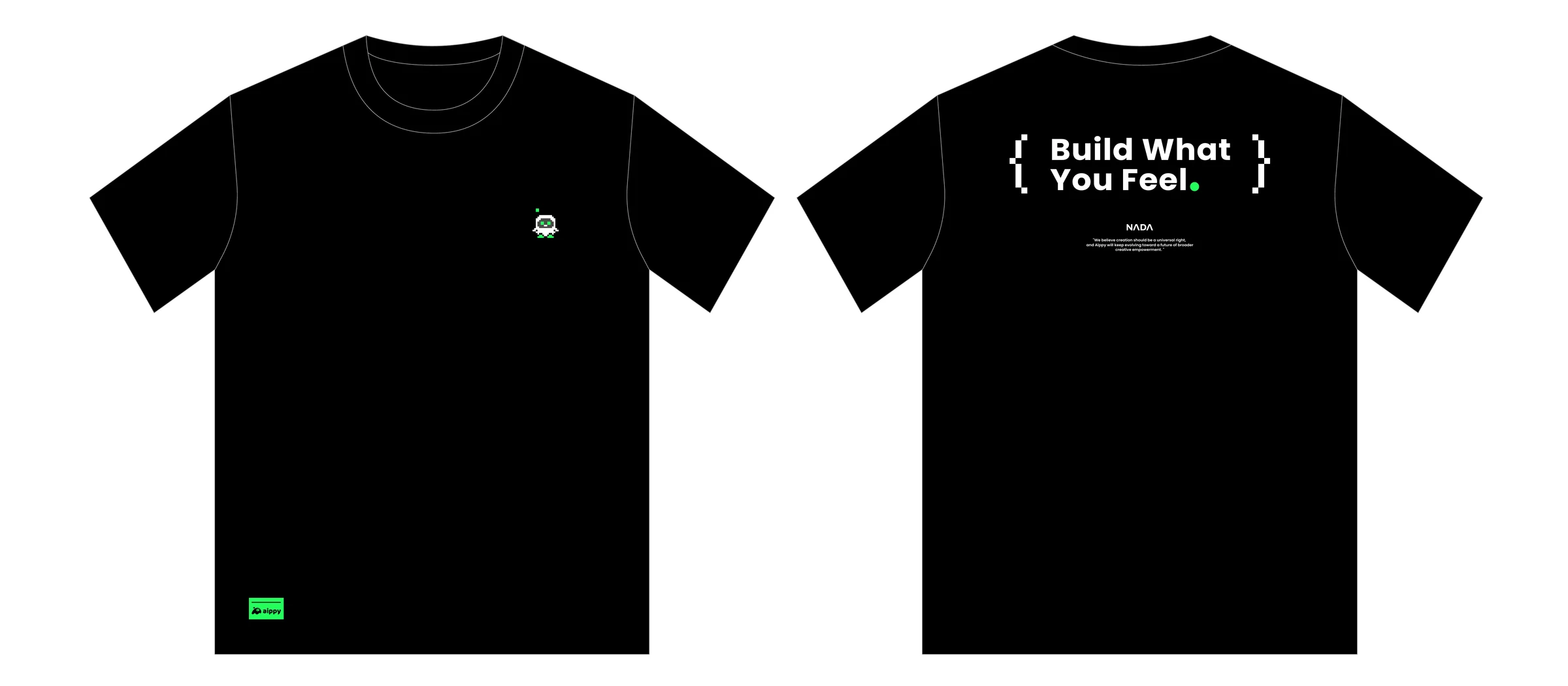
01 · SelectedCharacter + belief
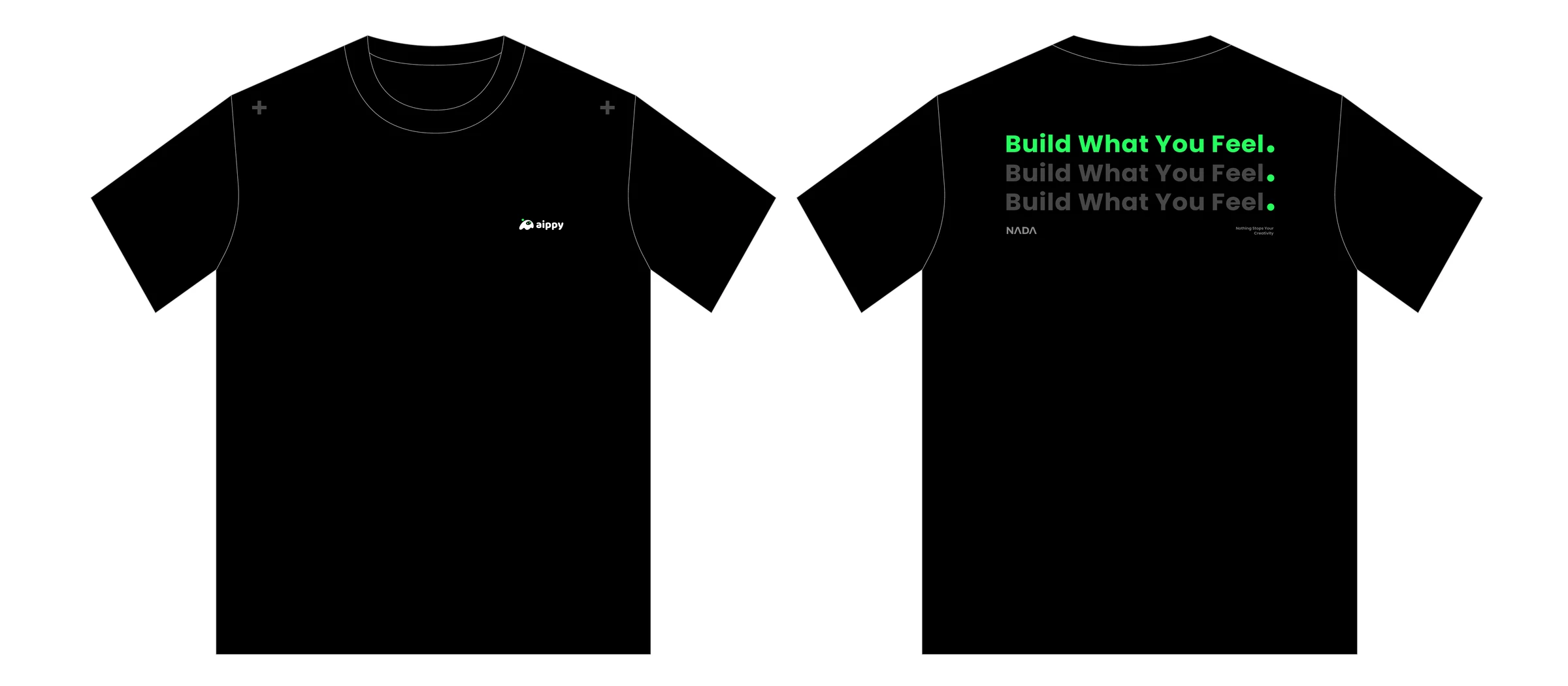
02 · StudyRepetition + momentum
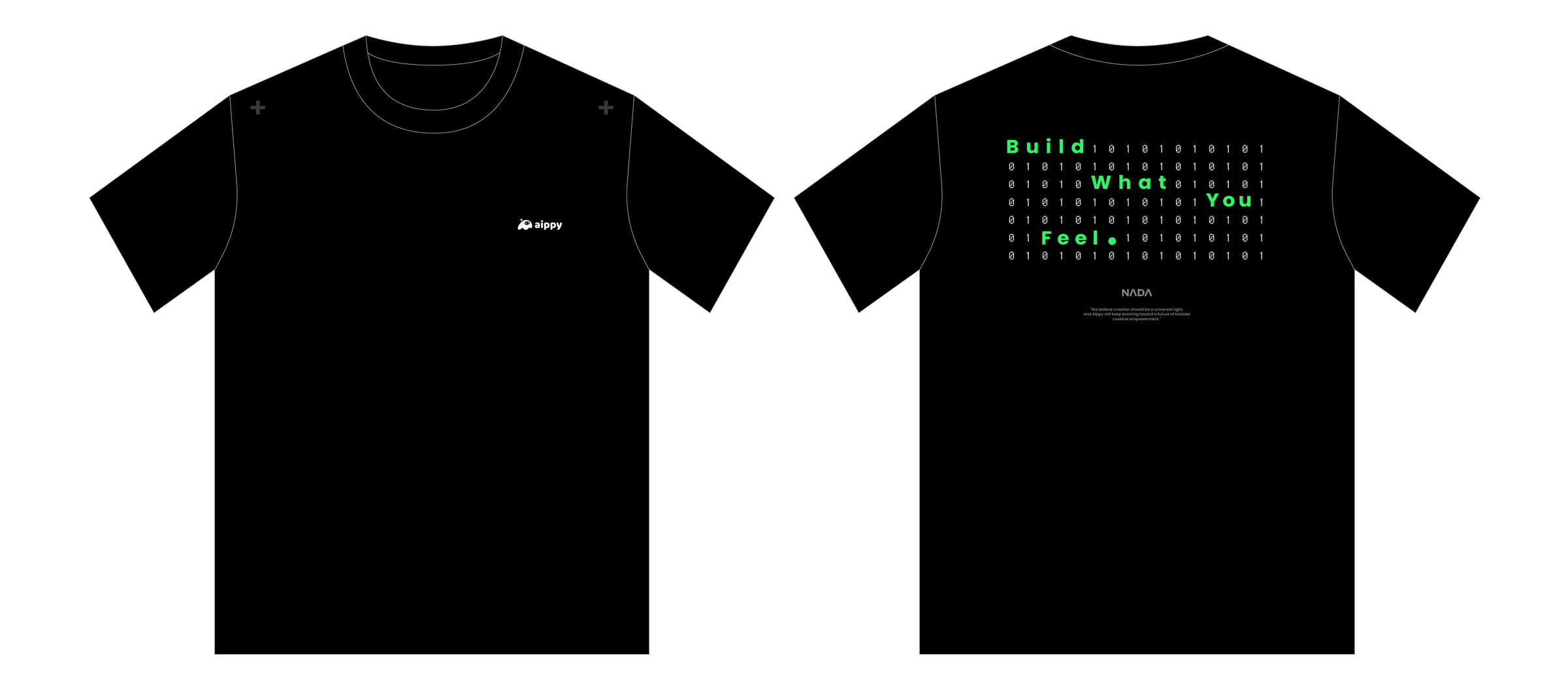
03 · StudyBinary field + discovery
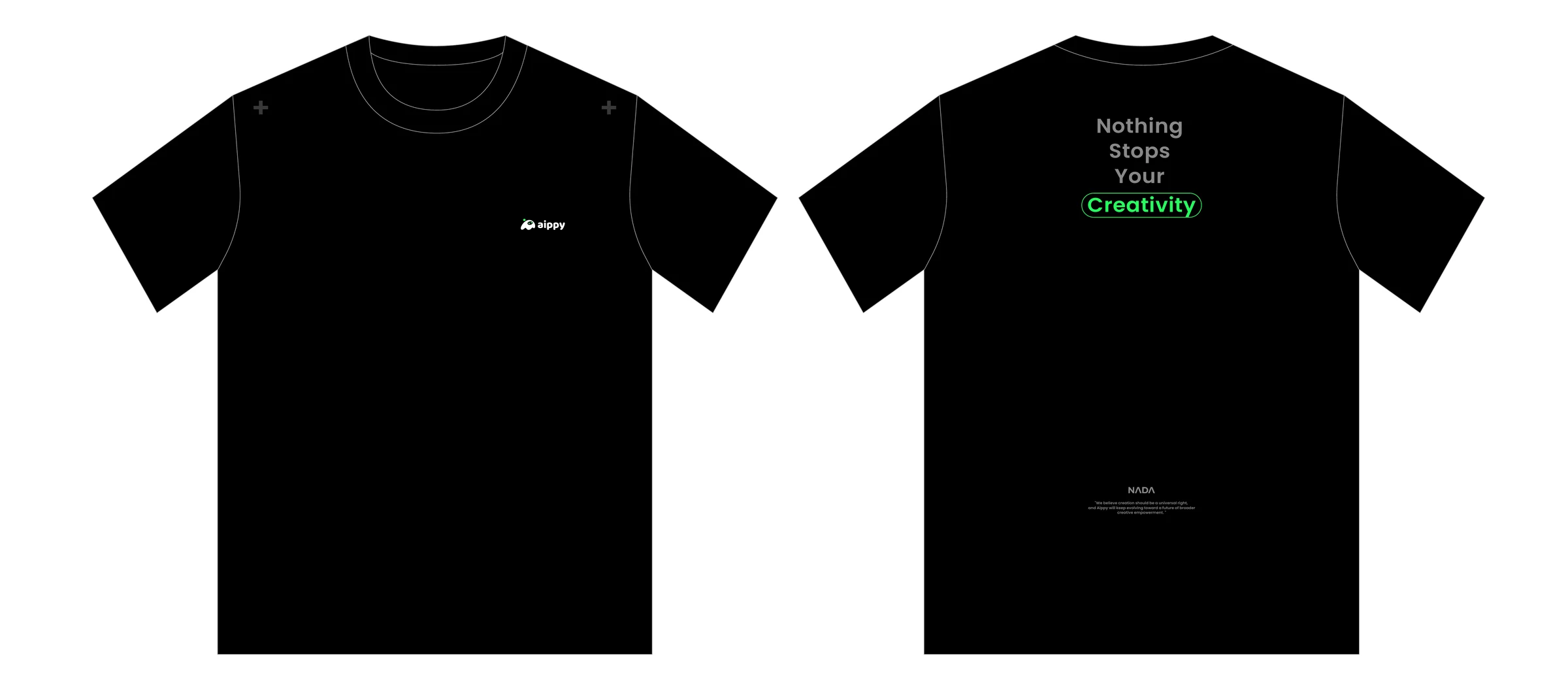
04 · StudyType stack + assertion
- 01One job per side
The front invites; the back declares. Neither competes with the other.
- 02One accent with a route
Green travels from antenna to eyes and feet, from hem label to final period.
- 03One idea the wearer can own
The sentence still feels personal after the logo, launch, and product context fall away.
05 · The wear test
The final edit happens in motion.
A flat composition can perfect hierarchy. It cannot tell you what survives a shoulder turning, a back folding, or a hem disappearing into a pocket.
On a body, every element has a failure mode. Boopy can disappear around the chest. A line break can collapse in a fold. The hem label can slip into a pocket. The spacing is generous because the shirt is rarely seen head-on.
Then comes the harder test: would it still feel right with no launch, no team photo, and no brand context? If yes, the garment has crossed from a company object to a personal choice. Aippy supplies the invitation; the wearer decides what it means.